RENAL CALCULI
Every day your kidneys work continuously to purify approximately 180 litres of blood by removing the waste products and maintaining the fluid balance in body. Yet there are certain minerals and salts become highly concentrated in urine, they begin to form hard deposits which are renal calculi, commonly known as kidney stones. While some stones end up unnoticed, others can cause one of the most severe condition that ends up in surgery.
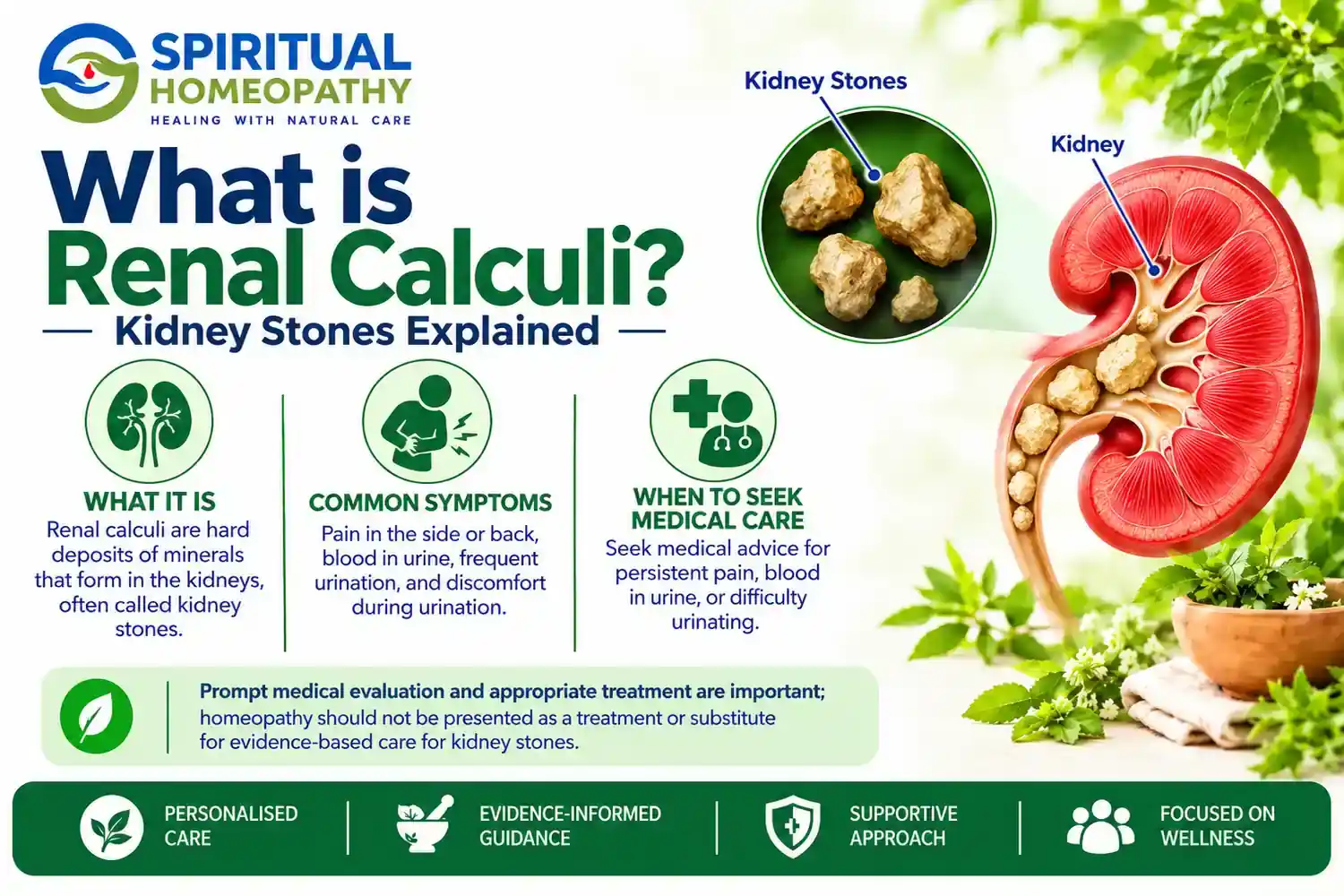
WHAT IS RENAL CALCULI?
These are solid, pebble like mineral deposits that form inside the kidneys when urine becomes too concentrated. They are composed of substances like calcium, oxalate and uric acid.
HOW DO KIDNEY STONES FORM?
Insufficient water intake
⬇️
Urine becomes highly concentrated
⬇️
Minerals & salts (calcium, oxalate, uric acid )
Exceed their solubility in urine
⬇️
Tiny crystals begin to form
⬇️
Crystal growth & aggregation by attracting more minerals
⬇️
Stone develops with in kidney
|
______________________
↓ ↓
Staysin kidney enters the ureter
No symptoms blocks urine with Severe pain, urinary symptoms, nausea, vomiting
WHAT ARE THE COMMON CAUSES?
- Inadequate water intake
- Excess animal protein
- Diet rich in oxalate containing foods
- Family history of kidney stones
- Obesity
- Diabetes/ hyperparathyroidism
- Recurrent urinary tract infection
- Certain medications
- Sedentary lifestyle
WHAT ARE THE COMMON SYMPTOMS?
- Severe pain in the flank
- Pain radiating towards loin
- Pain on urination
- Difficulty passing urine
- Burning pain during urination
- Frequent urge to urinate
- Blood in urine
- Fever with chills
- Nausea and vomiting
HOW TO DIAGNOSE RENAL CALCULI?
- Urine routine
- Urine culture
- Serum calcium
- Uric acid levels
- Electrolytes
- Serum creatinine
- CT KUB
ROLE OF HOMEOPATHY
Homeopathy aims to give patient centred care through personalized homeopathic treatment plan that focus on supporting long term urinary health. It offers an individualized approach to the management of kidney where every person’s unique symptoms, overall health and constitutional characteristics were considered rather than only focusing on the urinary complaints. The ultimate goal in homeopathy is to support natural immunity, healing process including urinary health and it also addresses factors that may contribute to the recurrence of kidney stones. Since every individual presents differently thus in homeopathy treatment is given based on detailed assessment of patient’s physical, emotional and overall history in order to support a better quality of life. Homeopathy should be considered a complimentary part of comprehensive health care plan.
| MYTH | FACTS |
| crystal clear urine means you don’t develop kidney stones | Not always, factors like genetics, metabolic disorder, recurrent infection can still lead to stone formation |
| once stone reaches bladder, the problem is over | It depends on size and location of stone |
| kidney stones are always visible on an x-ray | Not all stones, uric acid stones may require ultrasound |
| if you stone is small, you don’t need any treatment | Even a small stone can cause severe pain, increased frequency of urination. |
| kidney stones only affect kidneys | It not only affects kidney but anywhere along the urinary tract might get affected |
| kidney stones always cause severe pain | Not all the time, few kidney stones remain silent. |
| once a kidney stone passes, it doesn’t return | Kidney stones have a high recurrence rate. Lifestyle modifications can help reduce risk of recurrence. |
| all kidney stones require surgery | Surgery is necessary for only those stones which cause discomfort. |
✅DO’S
- Stay hydrated
- Eat balanced diet rich food
- Maintain a healthy body weight
- Limit salt intake
- Eat citrus rich foods
❌DON’TS
- Don’t ignore urinary complaints
- Avoid sugary soft drinks
- Don’t consume excess animal protein
- Do not self medicate
- Avoid sedentary lifestyle
- Avoid excess sodium
- Avoid self medication
👍KIDNEY FRIENDLY DIET
- Plant protein- lentil, chickpea, kidney beans, tofu
- Calcium rich- low fat milk, curd, paneer
- Whole grains- brown rice, whole wheat, quinoa, oats
- Citrate rich- lemon, orange, grapefruit
- Vegetables- bottle gourd, ridge gourd, pumpkin, cucumber, bell peppers
- Healthy fats- olive oil, flax seeds, avocado.
👎 FOODS TO AVOID
- High oxalate food- spinach, beetroot, sweet potato, chocolate, blacktea.
- Animal protein- red meat, processed meat, seafood
- High sodium foods- chips, instant noodles, pickles, fast food
- Carbonated drinks
- High sugar foods- cake, pastries, candies
WHY CHOOSE SPIRITUAL HOMEOPATHY?
At spiritual homeopathy, we believe true healing starts from case taking and medication is given based on the person’s constitution not just on the illness. At spiritual homeopathy, we follow our philosophy, which is based on compassionate care, meticulous care analysis and personalized treatment that helps in addressing every individual’s health journey. From your very first consultation to every follow up visit, our ultimate goal will be to provide you long term wellness, continuous support and individualized care. We ensure that every patient feels heard, respected and values throughout their healing journey. thousands of patients have trusted in spiritual homeopathy because of our commitment, dedication to our clinical excellence. Being one of the best homeopathy clinics in Hyderabad our team is still devoted to provide highest standard of homeopathic care with sincerity, integrity, compassion.
SPIRITUAL HOMEOPATHY- A PLACE WHERE PERSONALIZED CARE, CLINICAL EXPERTISE AND COMPASSIONATE HEALING COME TOGETHER TO HELP YOU TOWARDS A HEALTHIER TOMORROW.
Book your consultation with Spiritual Homeopathy Clinics for personalized healthcare guidance. Visit our branches in Dilsukhnagar, KPHB, or Nallagandla–Chandanagar. Call 9069 176 176 to schedule your appointment.
❓FREQUENTLY ASKED QUESTIONS
Usually stone moves through urinary tract, so whenever there is obstruction of urine or when stone touches the inner lining of ureter leads to pain.
Yes, although more common in adults, kidneys stones can occur in children due many factors such as genetics, dehydration, diet.
No, stones can be composed of calcium oxalate, calcium phosphate, uric acid and cystine.
Regular delaying of urination may contribute to urinary problems. Regular voiding improves urinary tract health.
As lemons contain citrate which may help reducing the formation of calcium stones.
The recurrence may be due to genetic tendency, diet, hydration or metabolic disorder.
Yes, when stones obstruct the normal flow of urine there is increased risk of infection.
No, most of the stones pass naturally by drinking large amounts of water.
It entirely depends on the type of stone. Calcium based stone cannot be dissolved. However, uric acid stones can be dissolved if you alter urine’s ph.
Calcium helps in binding with oxalates in your digestive tract rather than absorbing into your bloodstream and reaching to form stones.
Yes, over supplementing with vitamin C lead to elevated oxalate levels in urine which leads to kidney stones.
People with family history of stones, obesity, diabetes, gout, chronic dehydration have a higher risk.
It becomes dangerous if they block urine flow, repeated infections or reduce kidney functioning.
Adequate water, citrus fruits, vegetables, whole grains and balanced intake of dietary calcium will reduce its recurrence.
Yes, drinking enough fluids will flush out the excess mineral deposits in the blood.
No, stress does not directly form kidney stones. Long term stress usually ends up in dehydration, poor sleep and hormonal changes which indirectly leads to kidney stone development.
Yes, sometimes silent obstructions from stone can gradually impair kidney functioning.
Yes, prolonged fasting leads to dehydration. If post fasting dehydration is still persisting when there is a chance of developing renal calculi.
Yes, hot weather increases fluid loss through sweating making dehydration and increased risk of renal calculi.
Yes, long journeys ends up in limited water intake, delayed urination and improper diet will increase the risk.
Yes, recurrent urinary infections may be associated with certain stones.
Yes, usually small stones may naturally pass in urine without any discomfort.
The pain fluctuates because when ureter comes in contact with stone it keeps trying to push the stone downwards.
As lemon contains citrate, it prevents formation of calcium based stones.